|
|
Clause Test Description
* \4 }3 u8 N' g& m3 S! M" P7.14 Marking and instructions – Marking durability test
: {( U0 S2 s/ b; |' E2 ?8 Protection Against Access to Live Parts
1 }, R6 j9 D* r8 H! B- z* J10 Power input and current
8 P. V! t, U% A) L- }/ ~% _11 Heating Test) o" F1 I, K1 n3 P( n. n5 i
13 Leakage current and electric strength at operating temperature: X* U* N9 E; T7 b' V1 b, x
15.1 Moisture resistance – Protection degree against water test+ l/ K% Q. ?' B8 r
15.2 Moisture resistance – Spillage test
1 X4 w2 @6 c& C0 M8 `5 s* N- U15.3 Moisture resistance – Humidity test
" I( Z7 T) c) |3 @/ D. n16 Leakage current and electric strength
+ @1 C* F; @' C3 |1 Y& a- ?- p17 Overload protection of transformers and associated circuits9 g$ D2 t) @; T7 L
19.2 Abnormal operation – Restricted heat dissipation test (0,85 times power input): n5 _& j7 L h5 H/ R
19.3 Abnormal operation – Restricted heat dissipation test (1,24 times power input)
' ~( f& U; a7 _8 x19.4 Abnormal operation – Temperature control short-circuited test
# V/ p- \8 w' n5 v( J% K19.5 Abnormal operation – Test for class 0I and class I appliances with tubular sheathed or embedded heating elements
. \/ P/ a9 ?4 \% T- f; G19.6 Abnormal operation – PTC heating elements over voltage test
0 k8 f2 a# t# s9 V5 g19.7 Abnormal operation – Locking moving parts of motor test
& e* t0 c9 ?' t3 T7 N: k' U
( N0 _" L, X7 z, P& B7 |6 ~- i19.8 Abnormal operation – One phase disconnection test of 3 -phase appliance
" p( M/ L: e; |6 y19.9 Abnormal operation – Motor overload test2 \: Q$ m* \: o8 _: k- z
19.10 Abnormal operation – Series motor overspeed test' v# M% I1 _, n5 p$ O! [* ?" B
19.11.1 & 19.11.2 Abnormal operation – Fault condition of electronic circuit test$ B$ t2 ~6 t/ V' K% Q
19.11.3 Abnormal operation – Protective electronic circuit test
( U/ J) \/ l* M; |" j" P; n9 @19.11.4 Abnormal operation – EMP test2 S9 p- C3 }6 x
19.12 Abnormal operation – Current fuse reliability test(refer also to clause 19.11.2,19.11.3)# p0 h, G! G. w% M
19.13 Abnormal operation – Acceptance conditions after all abnormal operation tests
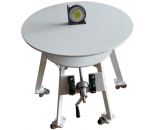
1 W. S1 S H+ x( p5 R' R" \/ H20.1 Stability and mechanical hazards – Stability test
: p. `/ F1 t% g; ~5 a j2 k20.2 Stability and mechanical hazards – Mechanical hazards test
6 K; _, J' P" k. X21.1 Mechanical strength – Impact test i$ }7 u- i* k' H3 D
21.2 Mechanical strength - Solid insulation strength
' }, g5 y% l7 O5 O0 D22.5 Construction – Plug discharge test; |8 L* n1 N" C7 S0 j$ t4 ]- [1 D
22.11 Construction – Non-detachable parts push and pull test
& ^1 Q' c" e9 U5 m' O22.12 Construction – Handles, knobs, grips and levels pull test
; d; @0 z# O( A: \22.16 Construction – Cord reel abrasion test
3 y+ M8 d; q S' X23.3 Internal wiring – Flexing test( o R) H" a! |8 I8 c+ B
23.5 Internal wiring – Insulation test9 m& c) _$ T, M
24.5 Components – Motor Capacitor resonance voltage measurement9 B: g- I2 \+ z3 L
25.14 Supply connection and external flexible cords – Flexing test
8 x* x2 \1 x: x# O3 W25.15 Supply connection and external flexible cords –Pull and torque test
! _5 G5 ^+ X7 ~- W; K( R3 q26.3 Terminals for external conductors – Torque test* y' n1 o+ P7 _. u% r& h; b
27.5 Provision for earthing – Earthing continuity test- |: B; a' e2 h6 X1 p
28.1 Screws and connections – Screws torque test. K2 O' y. _4 C5 y) B( K$ ?
29 Clearances, creepages distances and solid insulation5 Q9 F' w _- _
30.1 Resistance to heat and fire – Ball pressure test, V5 ~0 r! d% i/ A5 E; \. {
30.2 Resistance to heat and fire – Glow wire test9 Q/ j, r1 O: A: \2 t
30.2.4 Resistance to heat and fire –Needle flame test
$ Q7 l L# l' w) W5 sAnnex D Thermal motor protectors
3 m X; [- v5 F* xAnnex H Switches |
|
 [复制链接]
 /1
/1 
 |关于安规|小黑屋|安规QQ群|Archiver|手机版|安规网
( 粤ICP13023453-10 )
|关于安规|小黑屋|安规QQ群|Archiver|手机版|安规网
( 粤ICP13023453-10 )


 窥视卡
窥视卡 雷达卡
雷达卡 楼主
楼主


 显身卡
显身卡 发表于 2010-8-16 16:17

